
How to Make Cut Flowers Last Longer: The Wyldwood Guide to Cut Flower Care
There are few things better than bringing a fresh bunch of flowers home.
And while cut flowers are, by their very nature, fleeting, a little proper care can make a remarkable difference to how long they stay looking beautiful.
The good news is that keeping flowers fresh doesn't require a collection of strange household remedies or elaborate floral knowledge. A clean vase, fresh water, a good pair of snips and the right position in your home will do most of the heavy lifting.
Whether you've brought home one of our locally grown bouquets or picked up flowers elsewhere, this is our complete guide to caring for cut flowers. Including what actually helps, what doesn't, and what to do as your bouquet begins to age.
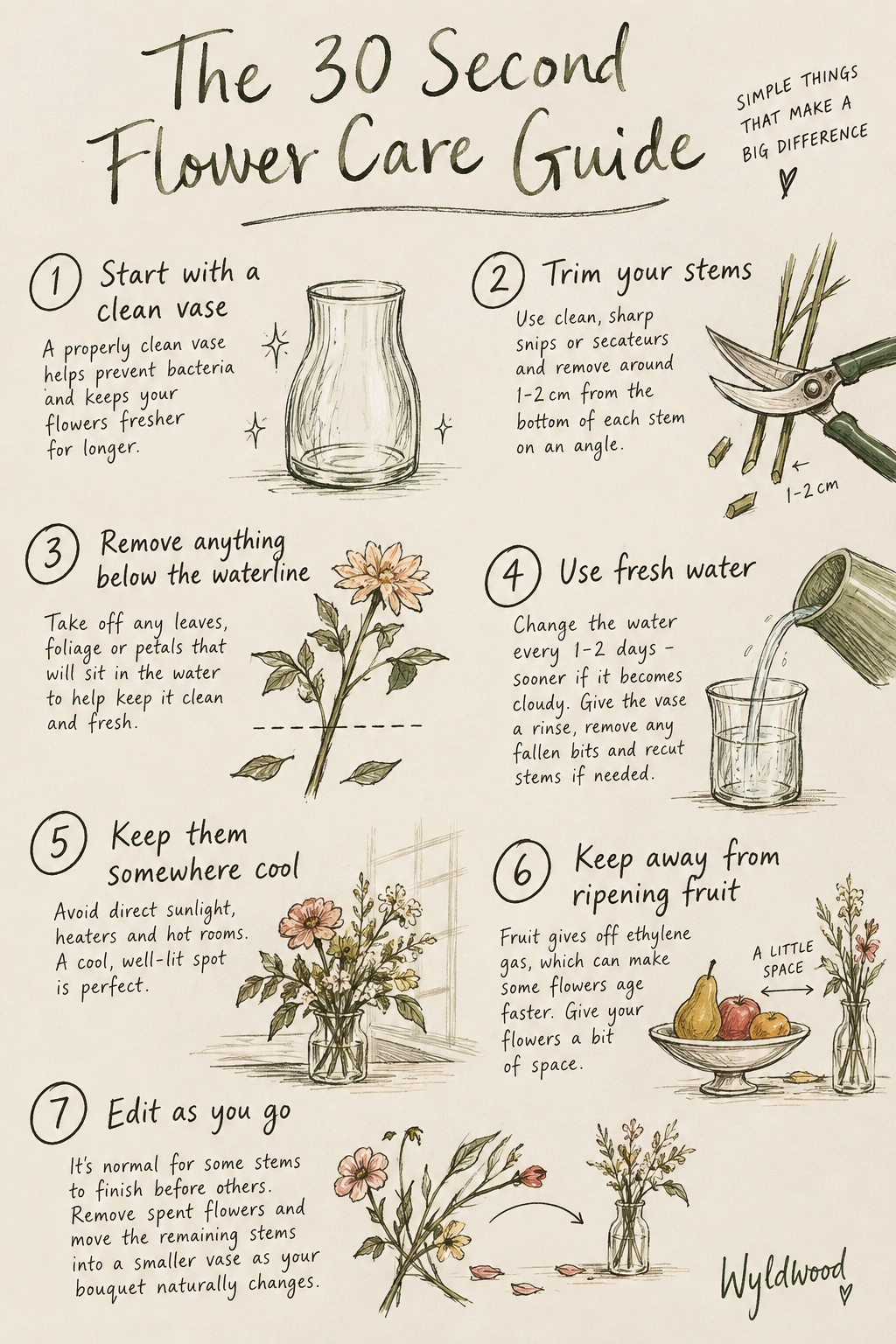
The Short Version
Keep your vase clean.
Keep your water fresh.
Keep leaves out of the water.
Give stems a clean, fresh cut.
Keep your flowers away from heat, harsh sun and ripening fruit.
Remove individual flowers as they finish.
And let the bouquet evolve.
First things first: get them into water
If you've received one of our wrapped bouquets, don't leave it sitting prettily on the bench for three hours while you decide which vase to use.
Flowers are thirsty.
Remove the wrapping and anything securing the bouquet that shouldn't be submerged. If you'd like to keep the arrangement exactly as we've designed it, you can leave the bouquet tied together while placing it into the vase.
Choose a clean vase and fill it with fresh, cool-to-room-temperature water.
And when we say clean vase, we mean properly clean.
Old vase water leaves behind bacteria and biofilm, even when the glass looks relatively innocent. That bacteria can multiply quickly in fresh water and interfere with the stems' ability to drink.
A quick rinse isn't always enough. Give your vase a proper wash between arrangements.
Give the stems a fresh cut
Before putting your flowers into water, trim approximately 1–2 cm from the bottom of each stem using clean, sharp secateurs or floral snips.
A fresh cut exposes the vascular tissue inside the stem, helping the flower take up water efficiently again.
We recommend cutting stems on an angle. It gives you a clean cut and helps prevent the cut end sitting completely flat against the bottom of the vase.
Avoid crushing or hacking through stems with blunt scissors. Damaged stem tissue doesn't take up water particularly well.
If your bouquet has been out of water for a while, giving it a fresh cut before returning it to the vase is especially important.
Leaves belong above the waterline
This is one of the simplest things you can do to extend vase life.
Remove any leaves, foliage or petals that will sit below the waterline.
Plant material submerged in water begins to break down. As it decomposes, it encourages bacterial growth — which is exactly what we're trying to avoid.
You don't need to strip your stems bare. Just make sure the part living underwater is nice and clean.
Fresh water is your best friend
Flowers drink through their stems, so the quality of the water they're sitting in matters.
Change the vase water every one to two days, rather than simply topping it up indefinitely.
When you change the water:
empty the old water completely
rinse or wash the vase
remove any fallen leaves or petals
check the stems for anything soft or slimy
give the stems another small trim if needed
refill with fresh water
If the water becomes cloudy, murky or develops an odour before your scheduled water change, don't wait. Change it.
Clean water is one of the most effective — and wonderfully boring — secrets to longer-lasting flowers.
Keep them cool
Your flowers may look excellent sitting in a shaft of afternoon sun.
They will not appreciate it.
Cut flowers generally last longer in a cool position away from direct sunlight and excessive heat. Keep them away from heaters, fireplaces and hot windowsills.
This doesn't mean they need to live in a dark corner of the house. Normal ambient light is perfectly fine. We're simply trying to avoid conditions that speed up water loss and ageing.
If your home gets particularly warm during a Sydney summer, moving your flowers somewhere cooler overnight can also help.
Flowers and fruit aren't always friends
That beautiful bowl of ripening fruit beside your vase may not be the idyllic still life you imagined.
Ripening fruit produces ethylene gas, a naturally occurring plant hormone involved in ripening and ageing. Many cut flowers are sensitive to ethylene, which can accelerate petal drop, wilting and senescence.
Apples, bananas, pears and avocados are among the usual suspects.
You don't need to banish fruit from the house — just give your flowers and fruit bowl a little breathing room.
Your bouquet isn't going to die all at once
This is perhaps our favourite bit of flower-care advice.
Edit your bouquet as it ages.
A mixed bouquet contains different species, varieties and stages of maturity, so it is completely normal for some stems to finish before others.
When a flower starts looking tired, remove it.
Don't throw away an entire arrangement because two stems have reached the end of their vase life.
As the bouquet gets smaller, move the remaining flowers into a smaller vase. A week later, perhaps you're down to three beautiful stems in a bud vase. Eventually there might be one tiny flower beside your bed.
We love this part.
A bouquet doesn't have to look exactly as it did on day one to still be beautiful.
What about droopy flowers?
A drooping flower isn't necessarily a dead flower.
If a stem suddenly looks sad, first check the basics.
Is there enough water in the vase? Is the water clean? Has the stem become blocked or damaged? Has the arrangement been sitting somewhere particularly hot?
Remove the affected stem, give it a fresh cut with clean, sharp snips and place it into fresh water somewhere cool.
Sometimes that's all it needs.
Other times, the flower has simply reached the natural end of its vase life — and that's okay too.
Do I need to add sugar, lemonade or a copper coin?
We love a household remedy as much as the next person, but your flowers don't need to become a science experiment.
Commercial flower food is specifically formulated to help cut flowers by balancing things such as nutrition, water pH and microbial growth.
If flower food has been supplied with your flowers, follow the directions on the packet — more isn't better.
We don't recommend randomly adding sugar, aspirin, coins, bleach, vodka, lemonade or whatever else the internet has decided flowers need this week.
When in doubt?
Clean vase.
Fresh water.
Clean cut.
Those three things will get you surprisingly far.
Woody stems need care too
Not everything in a Wyldwood arrangement behaves like a soft flower stem.
Branches and woody botanicals can benefit from a strong, clean cut using sharp secateurs. Depending on the botanical, they may need a slightly longer angled cut to expose enough fresh tissue to water.
There's no need to smash woody stems with a hammer.
Yes, people do this.
No, your kitchen does not need to become a botanical crime scene.
A sharp pair of secateurs will generally serve you much better.
A note about locally grown flowers
Locally grown, seasonal flowers can behave a little differently from the heavily standardised flowers we're accustomed to seeing in supermarkets.
You might notice curved stems, unusual shapes, tiny insect nibbles, natural variations in colour or flowers opening at different rates.
We consider those features, not faults.
Seasonal flowers haven't been designed to look identical 365 days a year. They reflect the conditions they were grown in and the point in the season at which they were harvested.
Some varieties naturally have an exceptional vase life. Others are glorious, delicate little things that give you a shorter but spectacular performance.
We choose flowers for their beauty, seasonality and character — not because they've been bred to survive indefinitely in a vase.
When it's finally time to say goodbye
Eventually, even the best-cared-for flowers will finish.
When they do, separate the arrangement rather than putting the entire thing straight into the bin.
At Wyldwood, we try to think about the whole lifecycle of our flowers, not just the pretty bit in the middle.
Compost suitable flowers and foliage where you can. Remove and reuse ribbons, mechanics or vessels. Recycle appropriate packaging, and keep anything that can have another life.
Some flowers also dry beautifully. If there's a stem you're particularly attached to, try hanging it upside down somewhere dry and well ventilated before it begins to deteriorate.
And if your flowers came in one of our reusable vessels, keep it, reuse it, or return eligible vessels through our Vase Library.
There is absolutely no rule saying a vase needs to wait for another bouquet, either. Fill it with garden clippings, herbs, interesting branches or whatever slightly odd botanical treasure you've found on your travels.
Flowers aren't permanent.
That's precisely why we think they're worth paying attention to.
Locally grown. Seasonally led. People and planet in mind.
— Wyldwood Collective